


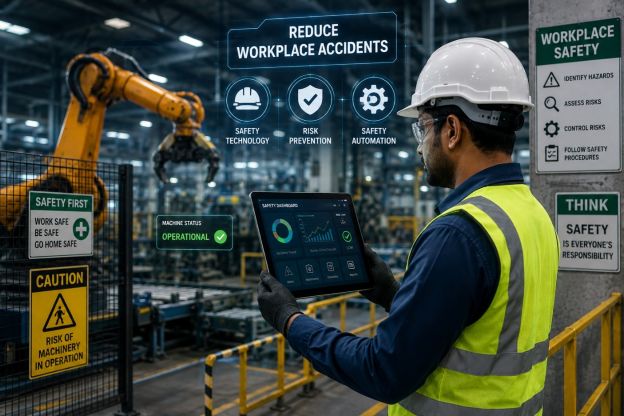
How to Reduce Workplace Accidents Using Modern Safety Tools
Workplace accidents continue to impose a significant human, financial, and operational burden on organizations across India and the wider global economy. Despite decades of legislative progress and growing institutional awareness, incidents resulting in injury, disability, or fatality remain disturbingly prevalent across high-risk sectors, including construction, manufacturing, logistics, mining, and chemicals.
The imperative to reduce workplace accidents has, in recent years, been met with an increasingly sophisticated array of modern safety tools. Advances in artificial intelligence, the Internet of Things, wearable technology, and safety automation have fundamentally altered what is possible in industrial risk prevention. This blog examines the most consequential of these tools, their practical application, and the shared benefits they deliver to both employers and workers.
The Limitations of Conventional Safety Approaches
Traditional safety management has historically relied upon periodic audits, compliance-driven checklists, and reactive incident investigation. While these mechanisms remain necessary components of any safety program, they are inherently insufficient as standalone strategies. They address safety failures after the fact rather than preventing them, and they depend heavily on human consistency — a variable that is, by nature, unreliable.
To meaningfully reduce workplace accidents at scale, organizations must transition from reactive compliance to proactive, data-driven, technology-enabled risk management. Modern safety tools provide precisely this capability.
Building a Proactive Workplace Accident Prevention Strategy
Effective workplace accident prevention does not depend on a single safety product or technology. Organizations should combine risk assessments, employee training, machine guarding, PPE and digital monitoring systems to create multiple layers of protection. Regular inspections and near-miss reporting can further help safety teams identify risks before they result in injuries.
The right industrial safety equipment should be selected according to the hazards present in each work environment. Depending on the application, this may include safety helmets, protective gloves, safety footwear, eye and face protection, respiratory protection, fall-protection systems and specialized equipment for hazardous environments.
Technology can strengthen these traditional controls. AI-enabled cameras can identify unsafe behavior, sensors can monitor environmental conditions and wearable devices can provide information about worker exposure or fatigue. Combining these solutions with proper training and safety procedures can create a more proactive approach to accident prevention.
Artificial Intelligence and Predictive Analytics
Artificial intelligence represents one of the most transformative developments in workplace applications. AI-powered computer vision systems can continuously monitor worksites, automatically detecting unsafe behaviors—such as the absence of required personal protective equipment, unauthorized entry into restricted zones, or hazardous manual handling postures—and generating real-time alerts before incidents can occur.
Predictive analytics platforms extend this capability further by analyzing historical incident data, near-miss records, and environmental conditions to identify patterns that precede accidents. This form of safety automation enables organizations to intervene proactively—deploying additional supervision, modifying work procedures, or suspending operations — based on data-derived risk intelligence rather than human intuition alone. The result is a measurable reduction in industrial risk and a fundamental shift in safety culture.
Wearable Safety Technology
Wearable devices have rapidly become a cornerstone of modern industrial risk prevention. Contemporary safety wearables encompass a broad range of functions: smart helmets equipped with impact sensors and communication systems, gas exposure monitoring badges that provide continuous personal environmental data, fatigue detection wristbands that alert supervisors when a worker's alertness deteriorates to unsafe levels, and ergonomic exoskeletons that reduce the physical strain associated with repetitive or heavy-lifting tasks.
The continuous biometric and environmental data generated by these devices enables real-time intervention and provides organizations with longitudinal health and safety trend data of considerable analytical value. For workers, wearable technology provides a layer of personalized protection that traditional safety systems are unable to replicate.
IoT-Connected Safety Systems and Safety Automation
The integration of the Internet of Things into workplace safety has enabled the development of interconnected safety ecosystems in which devices, machinery, and monitoring platforms communicate continuously and autonomously. Practical applications to reduce workplace accidents include connected gas detectors that automatically activate ventilation systems upon threshold breach, smart machinery that ceases operation when a worker enters a defined exclusion zone, and environmental sensors providing real-time monitoring of noise, temperature, and air quality across a facility.
This level of safety automation eliminates or significantly reduces the time lag between hazard emergence and corrective action—in many instances, removing the need for human intervention entirely. For organizations seeking to reduce workplace accidents in high-hazard environments, IoT-connected safety systems represent a critical investment.
OSH India Conference 2026: Shaping Safe and Healthy Workplaces in the Digital Era
The OSH India Conference 2026 will bring together safety professionals, industry leaders, technology experts, regulators, and workplace safety innovators to discuss the future of occupational safety and health in India. As industries continue to evolve with digital transformation, the conference will focus on how advanced technologies, proactive safety strategies, and strong leadership can help organisations create safer and healthier workplaces.
Unlike traditional safety approaches that focus mainly on compliance and incident response, the occupational safety and health conference India 2026 will highlight the shift towards predictive and preventive safety management. The discussions will explore how organisations can leverage emerging technologies such as Artificial Intelligence (AI), Internet of Things (IoT), smart PPE, robotics, automation, and immersive training solutions to identify risks earlier and prevent workplace accidents.
With industries across manufacturing, construction, energy, logistics, and infrastructure adopting smarter safety solutions, the conference will provide valuable insights into building a future-ready safety culture.
Key Topics Discussed at OSH India Conference 2026
The conference will bring together industry experts to discuss the latest trends, challenges, and solutions shaping the future of occupational safety and health.
1. Smart Factory Solutions and Real-Time Safety Monitoring
With the growth of Industry 4.0, smart factories are becoming an important part of modern safety management. Discussions will focus on how interconnected safety sensors, automated monitoring systems, and real-time data collection can help organisations identify workplace risks instantly and improve emergency response.
2. AI, Robotics and Automation for Safer Industrial Operations
Artificial Intelligence and automation are transforming industrial safety by reducing human exposure to hazardous environments. The conference will explore how AI-driven gripping systems, automated material-handling solutions, and robotics can improve precision, operational efficiency, and worker safety.
3. Adaptive Safety Systems for Changing Workplace Conditions
Modern workplaces require safety systems that can respond dynamically to changing operational and environmental conditions. Experts will discuss adaptive safety solutions that support continuous compliance, improve hazard detection, and strengthen workplace protection.
4. Predictive Safety Management and Advanced Risk Assessment
The move towards predictive safety is one of the biggest developments in occupational health and safety. The conference will highlight the role of wearable safety devices, predictive analytics, and automated emergency response systems in identifying risks before accidents occur.
5. Changing Global Safety Regulations and Compliance Requirements
As workplace safety standards continue to evolve globally, organisations need to upgrade their safety processes and technologies. Discussions will focus on changing regulatory requirements, environmental compliance, and strategies to help businesses maintain international safety standards.
6. Building Inclusive and Employee-Centric Safety Cultures
A strong safety culture goes beyond technology and compliance. The conference will address the importance of leadership involvement, employee engagement, mental health awareness, and ergonomic workplace solutions.
Special attention will be given to improving gender diversity within the occupational safety workforce and implementing gender-sensitive risk assessments to create safer and more inclusive workplaces.
Virtual Reality Training and Digital Permit-to-Work Systems
Effective safety training is one of the most reliable methods for reducing workplace accidents, and virtual reality has fundamentally elevated the standard of what training can achieve. VR platforms allow workers to experience realistic simulations of high-risk scenarios—confined space emergencies, chemical spills, and machinery entrapments—in a controlled and entirely safe environment. Research consistently demonstrates that immersive experiential training produces significantly greater knowledge retention and behavioral change than conventional classroom instruction.
Digital permit-to-work systems address a different but equally important dimension of industrial risk prevention: the procedural integrity of high-risk operations. By replacing paper-based permit systems with mobile-accessible digital platforms, organizations ensure that all relevant stakeholders — workers, supervisors, HSE managers, and site controllers — maintain real-time visibility of active permits, isolated equipment, and worker locations. The audit trails and automated workflows inherent in these platforms eliminate the procedural ambiguities that frequently precede serious incidents.
Benefits for Employers and Workers
The adoption of modern safety tools delivers distinct but complementary benefits to both employers and the workforce they are responsible for protecting.
For employers and management:
- Sustained reduction in lost-time injuries and the associated direct and indirect costs
- Reduced regulatory exposure and lower insurance premiums driven by improved safety performance
- Enhanced organizational reputation as a responsible employer, supporting talent acquisition and retention
- Data-driven safety management enabling continuous performance improvement
Frequently Asked Questions (FAQs)
Q1. What is the most effective modern tool to reduce workplace accidents in Indian industries?
The most effective approach is an integrated one. AI-powered hazard detection, IoT-connected safety systems, and wearable technology each address different dimensions of risk. When deployed in combination and supported by digital safety management platforms, these tools produce significantly greater risk reduction than any single-tool implementation.
Q2. Is safety automation feasible for small and medium enterprises in India?
Yes. Many safety automation solutions are now available as affordable, subscription-based or modular platforms specifically designed for organizations with constrained safety budgets. Cloud-based safety management software and low-cost IoT sensor networks make industrial risk prevention technology accessible well beyond large industrial organizations.
Q3. How does predictive analytics differ from conventional incident investigation?
Conventional incident investigation identifies what went wrong after an accident has occurred. Predictive analytics analyzes historical and real-time data to identify conditions and patterns that precede incidents, enabling organizations to intervene before harm materializes. This is the defining distinction between reactive and proactive safety management.
Q4. How should organizations begin implementing modern safety tools?
Implementation should commence with a structured technology-readiness risk assessment that identifies the incident types and contributing factors most prevalent in the organization. Tool selection should be aligned to this assessment, and deployment should be preceded by comprehensive training. Measurable safety performance metrics must be established prior to deployment to enable objective evaluation of impact.
Q5. Where can safety professionals in India access demonstrations of modern safety tools?
Safety exhibitions are the most efficient venue for evaluating modern workplace safety technology solutions. Events such as OSH India bring together technology providers, industry experts, and regulatory bodies, offering hands-on demonstrations and expert-led sessions that enable informed procurement decisions.
Discover the Future of Workplace Safety at OSH India — October 2026
India's Premier Occupational Safety & Health ExhibitionFor organizations committed to reducing workplace accidents through the adoption of modern safety tools, OSH India — scheduled for October 2026 — represents the foremost opportunity in India to evaluate, compare, and engage with the full spectrum of available safety technology. From AI-powered surveillance platforms and IoT safety systems to wearable solutions and immersive VR training environments, OSH India 2026 will showcase the innovations shaping the future of industrial risk prevention across India's major sectors.
Co-located conferences, regulatory engagement sessions, and dedicated networking programs ensure that every attendee—whether an exhibitor or a visitor—derives maximum professional and organizational value from their participation.